OSDU as your data backbone. Yours, not theirs.
tu data. no la suya.
A multi-tenant OSDU stack already loaded with 1.35M production records from Argentina's public registry. Browse it, query it, hand it to a regulator on Monday.
You don't own your subsurface data. You rent access to it.
Your wells live in a vendor's schema. Your production history sits in three vendor portals with three vendor logins. When the regulator asks who edited what and when, you open a ticket and wait. When you switch vendors, you pay to export your own data back to yourself. OSDU was supposed to fix this. In practice, most “OSDU offerings” are the same lock-in with a new sticker. We built one that isn't.
What an OSDU stack looks like when you actually run it.
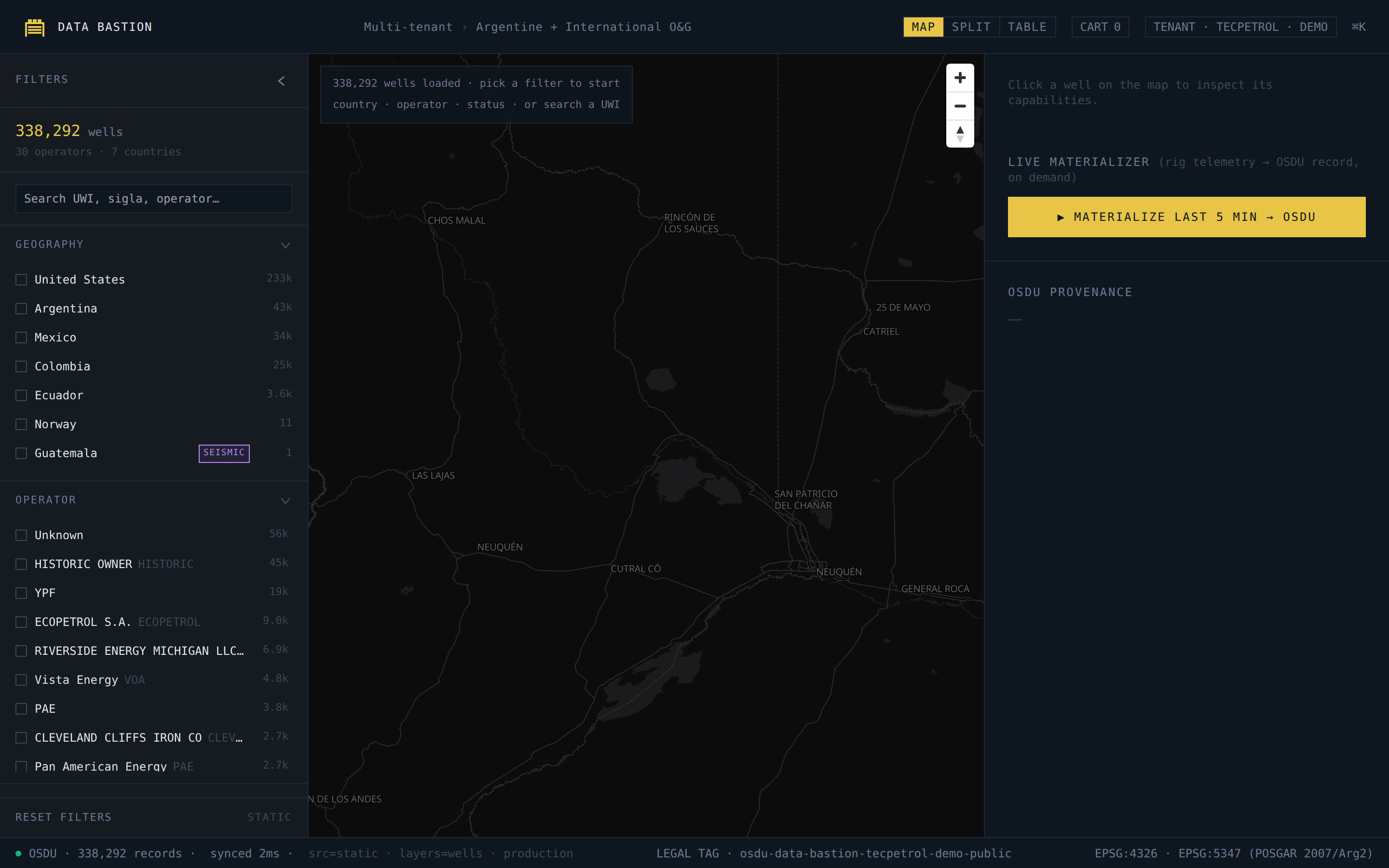
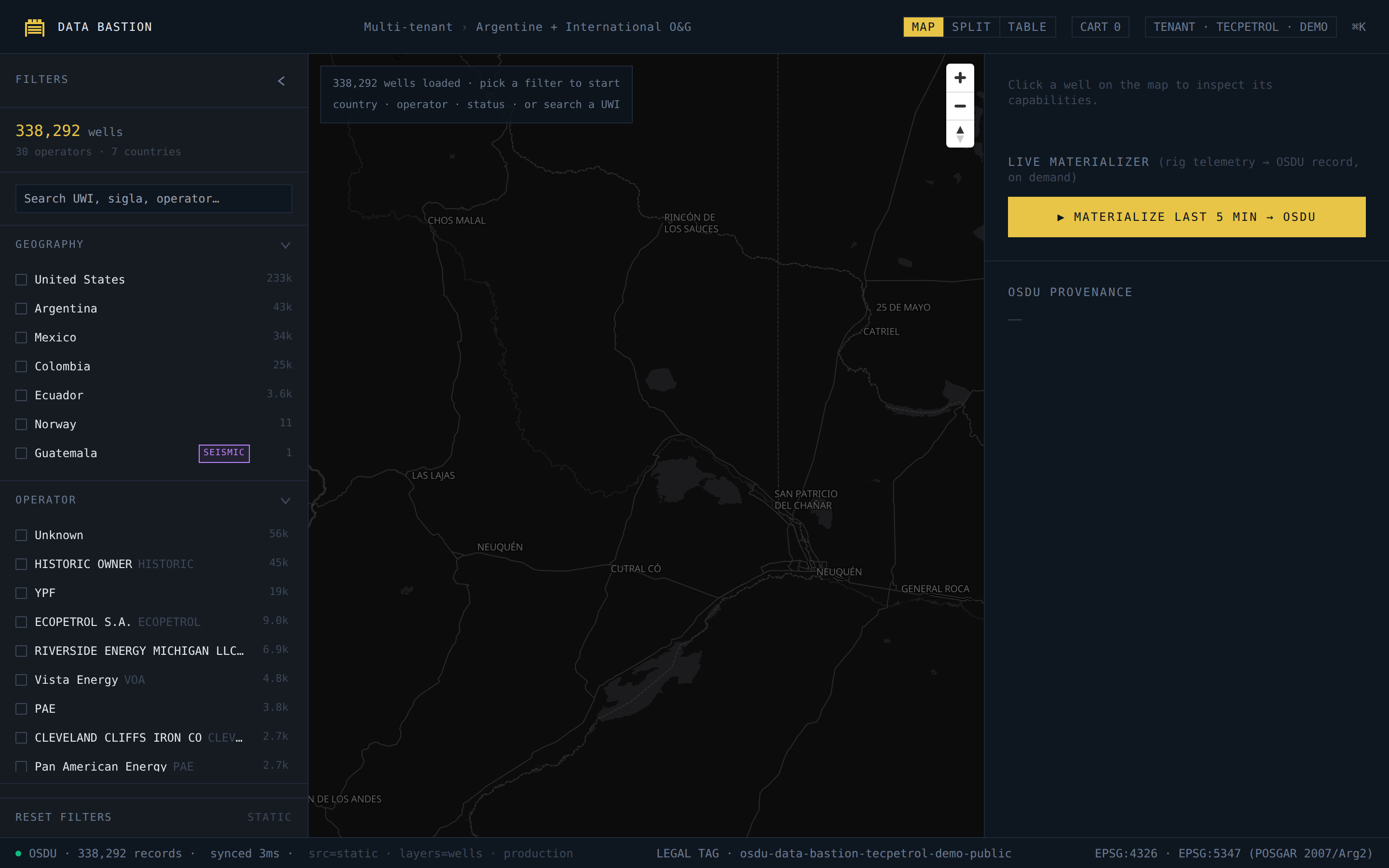
Open the demo. You land on a well browser pulling live from an OSDU
partition — 338,292
wells indexed against Aramco Standard 1.0.0. Click a well: you see its
trajectory, its production curve, its formation tops, and the exact
OSDU record id behind every field. No proprietary IDs. No wrapper
schema. The same /api/storage/v2/records/{id} your data
engineers will hit on day one.
Behind the browser: Mosquitto for telemetry ingest, Redpanda for the bus, TimescaleDB for hot history, MinIO for bulk, PostGIS for the map, and an OSDU materializer that turns rig signal into canonical records on a schedule you control. You run it. You see every layer.
The numbers are loaded. Click any of them.
Every number on this page points to a live record set in the demo cluster — not a slide.
1,350,000 ProductionVolumes — twelve years of monthly volumes from 256 Tecpetrol-operated wells, proving the platform serves production at corpus scale. 338,292 Wells — the full Argentina Secretaría de Energía registry, OSDU-canonical. 16,167 MarkerSets — formation tops linked to their wells; the relational graph is intact. 1,004 Trajectories — directional surveys, queryable by well; geometry layer works end-to-end.
A 90-day pilot, scoped tight.
Bring one of your basins. We'll stand up a partition, load your wells against OSDU Aramco Standard 1.0.0, and hand you the keys.
- Days 1–30: your corpus loaded, your legal tags applied, your team has viewer accounts.
- Days 31–60: one live telemetry source materializing into canonical OSDU records.
- Days 61–90: audit trail proven against a regulator-style query. Go / no-go.